

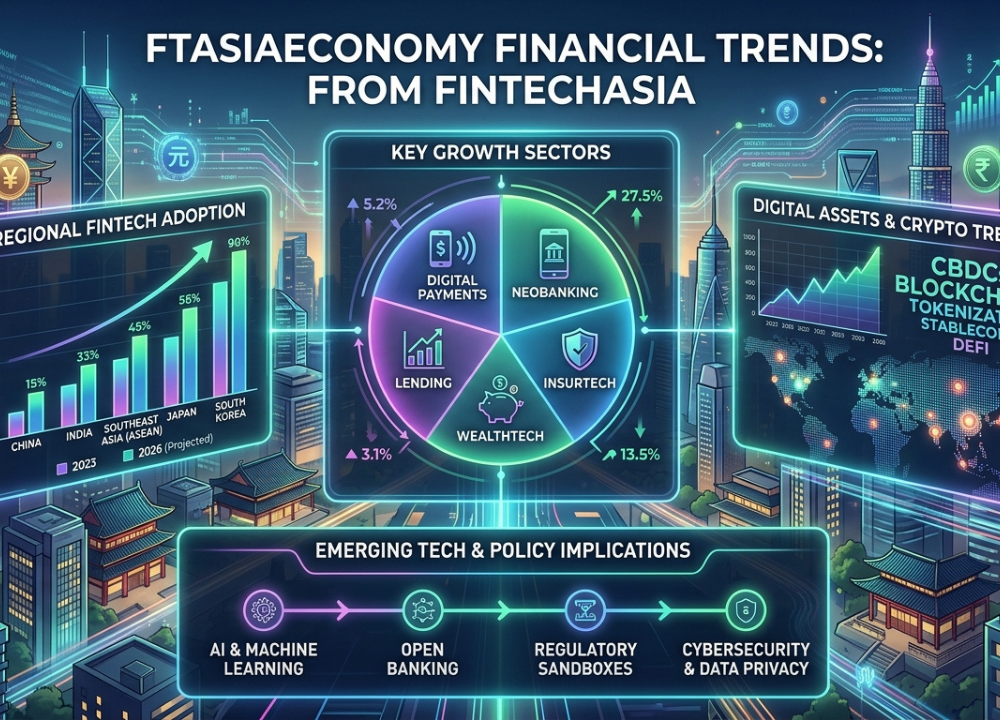
The financial world in Asia is changing at a remarkable pace. Mobile payments, digital banking, artificial intelligence, open finance, embedded financial services, and faster cross-border transfers are moving from emerging ideas into everyday financial infrastructure. For readers trying to understand these changes, ftasiaeconomy financial trends from fintechasia provides a useful phrase for exploring the relationship between technology, markets, and financial services.
What makes this topic especially interesting is that fintech is no longer only about convenient apps. It increasingly affects how businesses receive payments, how lenders evaluate customers, how investors assess opportunities, and how regulators manage new risks. Recent coverage of Asian fintech trends points to continued growth in digital payments, embedded finance, AI, and cross-border financial infrastructure, while also showing greater attention to profitability, cybersecurity, and regulation.
What Does Ftasiaeconomy Financial Trends From FintechAsia Mean?
The phrase ftasiaeconomy financial trends from fintechasia can be understood as a way of describing financial and economic developments connected with fintech in Asia. It brings together two ideas: the changing economy and the technology that is reshaping financial services. The term should not automatically be treated as the name of one official financial index or government report. Search results contain several similarly named websites and articles, so readers should check the exact publisher and original source before accepting a statistic or market claim. One recent FintechAsia article, for example, frames the topic around payments, lending, investment, regulation, and macroeconomic conditions in Asia.
In practical terms, the subject covers questions such as:
- How quickly are digital payments growing?
- How are mobile wallets changing consumer behavior?
- Where is AI being used in banking and lending?
- How are fintech companies improving access to finance?
- What regulatory and cybersecurity challenges are emerging?
- How could these developments affect businesses and consumers?
Why Asian Fintech Trends Matter
Asia contains some of the world’s most active digital-finance markets, but the region is not one uniform market. Countries differ in income levels, regulation, payment infrastructure, banking penetration, consumer behavior, and digital identity systems. That diversity creates both opportunities and challenges. A payment solution that works extremely well in one country may need substantial changes before it can operate elsewhere. Local partnerships, regulatory permissions, language support, and integration with existing payment rails can all affect expansion.
The current ftasiaeconomy financial trends from fintechasia conversation is therefore broader than simply asking which fintech app is popular. It is about how financial infrastructure evolves and how that evolution affects economic activity.
Key Financial Trends Shaping Asian Fintech
Digital Payments and Mobile Wallets
Digital payments are among the most visible changes in Asian finance. Consumers increasingly expect payments to be quick, convenient, and available through smartphones. QR codes, mobile wallets, contactless payments, and real-time payment networks have made electronic transactions easier for both consumers and merchants. Recent reporting on Asian fintech also highlights a shift toward improving the economics of payment businesses. Companies are adding merchant services, subscriptions, analytics, lending, and other higher-value products because payment margins can become tighter as competition increases.
Digital Banking
Digital banking is another major theme. Customers increasingly expect to open accounts, transfer money, monitor spending, and access financial products without visiting a physical branch. For banks, the change is more fundamental than simply creating a mobile application. Institutions are modernizing internal systems, APIs, customer onboarding, fraud controls, and data infrastructure. Fintech startups are also partnering with established banks rather than always competing with them directly.
The ftasiaeconomy financial trends from fintechasia perspective highlights why digital banking should be viewed as infrastructure rather than a short-lived consumer trend. The strongest digital services generally solve a clear problem: faster onboarding, lower friction, better access, or more useful financial information.
Artificial Intelligence in Finance
Artificial intelligence is moving deeper into financial operations. Banks and fintech companies can use machine learning and related technologies for fraud detection, customer support, risk analysis, document processing, and credit assessment. The most useful applications are often behind the scenes. A customer may never see the model that helps identify a suspicious transaction, but that technology can still affect the speed and security of the service.
AI-enabled payments are also becoming a practical area of experimentation. Reuters reported in September 2026 that India was preparing a framework for AI agents to make small digital payments under defined controls. Such developments suggest that the next stage of fintech may involve software acting on behalf of customers within specified rules.
Embedded Finance
Embedded finance places financial services inside platforms people already use. An online marketplace might offer payments or merchant financing, while a transportation platform could integrate insurance or financial services into its customer journey. This model can reduce friction because users do not need to leave the platform to access a financial product. For businesses, embedded finance can create new revenue opportunities and strengthen customer relationships.
Cross-Border Payments and Remittances
Cross-border payments remain a major opportunity because international transfers can involve multiple intermediaries, currency conversions, compliance checks, and settlement processes. Fintech providers are working to make these transfers faster and more efficient. Central bank digital currency experiments, payment connectivity projects, liquidity optimization, and API-based financial infrastructure are all part of the broader discussion.
For migrant workers and international businesses, improvements in cross-border payments can have a direct economic effect. Lower costs mean more money reaches recipients, while faster settlement can improve business cash flow.
Blockchain, Tokenization, and Digital Assets
Blockchain continues to attract attention because it can provide shared records and programmable transactions. Financial institutions are exploring applications such as tokenized securities, settlement systems, digital identity, and selected forms of decentralized finance. Tokenization is particularly interesting because it may allow certain traditional assets to be represented digitally. However, adoption depends on legal frameworks, custody arrangements, investor protection, interoperability, and market demand.
The ftasiaeconomy financial trends from fintechasia discussion should therefore treat blockchain as an area of experimentation and infrastructure development rather than assuming every digital-asset project will succeed.
Financial Inclusion
One of fintech’s strongest potential benefits is broader access to financial services. Smartphone-based accounts, digital payments, alternative credit assessment, and low-cost transfers can help people who have historically faced barriers to traditional banking. Financial inclusion can also support small businesses. A merchant that gains reliable digital payment acceptance and access to transaction records may have more opportunities to obtain working capital or other financial services.
The Economic Impact of Fintech Trends
The broader ftasiaeconomy financial trends from fintechasia story is ultimately about economic activity, not technology alone. When payments become faster, businesses can collect revenue more efficiently. When financial onboarding becomes easier, more people can participate in formal financial systems. When data can be used responsibly for risk assessment, lenders may be able to serve customers who were previously difficult to evaluate. Fintech can also change competition. New entrants may challenge established banks, while banks may respond by building their own digital products or partnering with fintech companies.
What These Trends Mean for Businesses
For businesses studying ftasiaeconomy financial trends from fintechasia, the landscape creates both opportunities and responsibilities. Companies can benefit by adopting digital payment systems, improving financial automation, using data responsibly, and offering customers more convenient financial experiences. Small and medium-sized businesses may also benefit from digital lending, invoice tools, embedded finance, and faster settlement.
Cybersecurity and Regulation
Every increase in digital financial activity creates a larger security surface. Payment accounts, APIs, mobile applications, customer databases, and cloud infrastructure can all become targets for fraud or cyberattacks. The ftasiaeconomy financial trends from fintechasia discussion therefore cannot be separated from cybersecurity. Businesses need strong authentication, access controls, monitoring, incident-response procedures, vendor reviews, and employee awareness.
How to Evaluate Fintech Financial Information
Readers should approach online financial trend articles with healthy skepticism. A professional-looking website or a frequently repeated claim does not automatically make a statistic reliable. Start by identifying the original source. If an article cites a central bank, payment network, government agency, audited company filing, or established research organization, look for the original document when possible. The ftasiaeconomy financial trends from fintechasia topic is most useful when readers combine industry commentary with primary sources and independent evidence.
A Practical Comparison of Major Trends
| Trend | Main Development | Potential Benefit | Key Risk |
| Digital payments | Mobile, QR, and instant payments | Faster transactions | Fraud and outages |
| Digital banking | Online-first financial services | Convenience and access | Cybersecurity |
| AI in finance | Automated analysis and decisions | Efficiency and personalization | Bias and privacy |
| Embedded finance | Finance built into platforms | Lower customer friction | Compliance complexity |
| Cross-border payments | Faster international transfers | Lower cost and better speed | Regulatory differences |
| Tokenization | Digital representation of assets | New market infrastructure | Legal and liquidity risks |
| Financial inclusion | Broader access to services | Wider participation | Digital access gaps |
How Consumers Can Benefit Safely
Consumers following ftasiaeconomy financial trends from fintechasia can benefit from fintech without adopting every new product they see. Before opening an account or using a financial app, check who operates the service, what fees apply, how customer data is handled, and whether the provider is properly authorized where required. Good security habits remain essential. Use strong, unique passwords, enable multi-factor authentication, keep devices updated, and avoid clicking suspicious financial links. Never share one-time passwords or account credentials with someone who contacts you unexpectedly.
What the Future May Look Like
The future of Asian fintech, viewed through ftasiaeconomy financial trends from fintechasia, is likely to be less about one revolutionary technology and more about several systems working together. Real-time payments, AI, digital identity, open APIs, cloud infrastructure, tokenization, and embedded financial services can increasingly connect into a broader digital ecosystem. The ftasiaeconomy financial trends from fintechasia outlook points toward greater integration between financial technology and everyday commerce. The boundary between a banking product and a non-financial digital service may continue to become less obvious.
Final Thoughts
The financial landscape across Asia is becoming more digital, connected, and data-driven. Digital payments are expanding, banks are modernizing, AI is entering financial operations, and embedded finance is bringing financial services into everyday platforms. At the same time, cybersecurity, privacy, regulation, and sustainable business models are becoming just as important as technological innovation. The most useful way to understand ftasiaeconomy financial trends from fintechasia is to look beyond individual apps or headlines. The bigger story is the gradual transformation of financial infrastructure and the way that transformation affects consumers, businesses, investors, and policymakers.
FAQs
Q1: What is ftasiaeconomy financial trends from fintechasia?
Ans: The phrase describes financial and fintech developments associated with Asian markets, including digital payments, banking technology, AI, lending, embedded finance, cross-border payments, and regulation. It is best treated as a topic or search phrase rather than automatically assuming it refers to one official financial index.
Q2: What are the main fintech trends in Asia?
Ans: Major trends include digital payments, mobile banking, artificial intelligence, embedded finance, open finance, cross-border payment infrastructure, tokenization, and financial inclusion. Regulatory and cybersecurity developments are also becoming increasingly important.
Q3: Why are digital payments growing across Asia?
Ans: Smartphone adoption, merchant acceptance, convenient user experiences, real-time payment infrastructure, and growing digital commerce are major drivers. Different countries are developing at different speeds, so local infrastructure and regulation also matter.
Q4: How is AI changing financial services?
Ans: AI can support fraud detection, customer service, risk assessment, document processing, credit analysis, and personalization. Its use also creates challenges involving privacy, explainability, bias, and governance.
Q5: What is embedded finance?
Ans: Embedded finance means integrating financial services into non-financial platforms or customer journeys. Examples include payments, lending, insurance, or financial accounts offered within e-commerce, transportation, or other digital services.
Q6: Is fintech good for financial inclusion?
Ans: Fintech can improve access by lowering barriers to payments, accounts, credit, and other services. Its effectiveness depends on affordable connectivity, digital literacy, appropriate regulation, consumer protection, and reliable infrastructure.
Q7: What are the biggest risks in fintech?
Ans: Major risks include cybersecurity attacks, fraud, privacy breaches, poor risk management, regulatory violations, technology outages, and inappropriate use of automated decision-making.
