

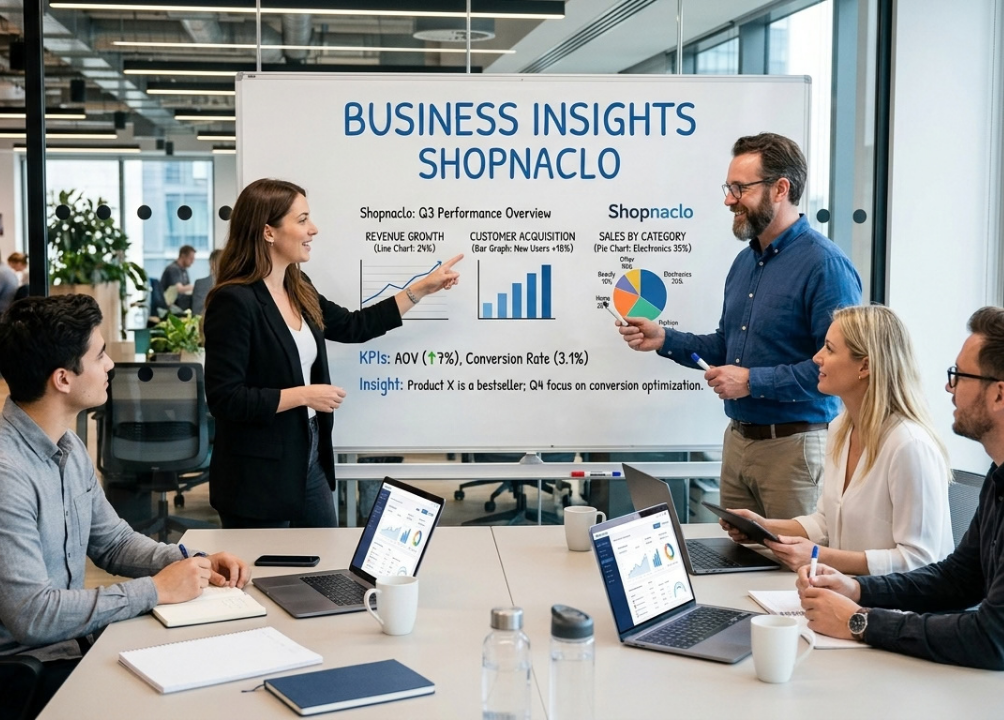
Understanding business information is becoming increasingly important for entrepreneurs, retailers, marketers, and professionals. Businesses generate large amounts of information through sales, customer activity, marketing campaigns, product performance, and operating costs. The challenge is turning that information into useful knowledge that can support practical decisions.
Business Insights Shopnaclo is a search term associated with ShopNaclo’s business-focused information and analysis. ShopNaclo currently presents itself as a digital resource covering business and finance topics, including business resources, investment information, taxes, loans, and saving strategies.
Its dedicated Business Insights article focuses more specifically on using business data to understand performance, customer behavior, products, inventory, marketing, and growth.
What Is Business Insights Shopnaclo?
Business Insights Shopnaclo can be understood as a reference to business-oriented insights associated with ShopNaclo. In practical terms, the subject involves examining information that can help a business understand what is happening and determine which areas deserve attention. Business insights are different from raw data. A spreadsheet containing hundreds of transactions is data. Discovering that repeat customers generate a larger share of revenue than first-time buyers is an insight because it provides context that can influence a business decision.
Why the Term Matters
People searching for this topic may be interested in understanding how business information can be used for:
- Performance monitoring
- Customer analysis
- Marketing decisions
- Product planning
- Inventory management
- Growth strategies
- Business research
How Business Insights Work
Business Insights Shopnaclo is most useful when considered as part of a broader data-driven decision-making process.
A typical process can be divided into four stages:
- Collect information
- Organize the information
- Identify meaningful patterns
- Turn findings into actions
From Data to Action
A useful insight should answer a practical question.
Instead of asking, “What does the data say?” a business can ask:
- What changed?
- Why might it have changed?
- Is the change temporary or consistent?
- What business area does it affect?
- What should be tested next?
Key Areas Covered by Business Insights
Business Insights Shopnaclo can be examined through several important business areas, particularly those highlighted in ShopNaclo’s published analysis.
Business Performance
Performance metrics help businesses understand whether their current activities are producing the desired results.
Common examples include:
- Revenue
- Conversion rate
- Average order value
- Gross margin
- Customer acquisition cost
- Customer lifetime value
- Repeat purchase rate
- Churn rate
Customer Behavior
Customer insights can help explain who buys, what they purchase, how frequently they return, and which factors influence their decisions. ShopNaclo’s business article describes several customer segments, including value-focused shoppers, convenience buyers, and returning customers.
Product and Inventory Performance
Product data can provide information about which items sell quickly, which products produce stronger margins, and which products remain in stock for extended periods. ShopNaclo’s published analysis recommends connecting product information with margin, return-rate, and holding-cost signals. That type of analysis can be useful because high sales volume does not automatically mean a product is highly profitable.
Marketing Performance
Marketing insights help businesses determine which activities are producing meaningful results.
Useful measurements can include:
- Website traffic
- Conversion rate
- Advertising cost
- Return on ad spend
- Email engagement
- Customer acquisition cost
- Repeat purchases
Important Metrics to Understand
Business Insights Shopnaclo becomes easier to understand when common business metrics are clearly defined.
| Metric | What It Measures | Why It Can Matter |
| Conversion Rate | Percentage of visitors who complete a desired action | Helps evaluate customer journeys |
| Average Order Value | Average amount spent per order | Shows purchasing value |
| Customer Acquisition Cost | Cost of gaining a customer | Helps evaluate acquisition efficiency |
| Gross Margin | Revenue remaining after relevant direct costs | Helps assess profitability |
| Customer Lifetime Value | Estimated value generated by a customer over time | Helps evaluate long-term customer relationships |
| Repeat Purchase Rate | Share of customers who purchase again | Provides insight into retention |
| Churn Rate | Rate at which customers stop using a service or relationship | Can highlight retention issues |
How to Use Business Insights for Better Decisions
Business Insights Shopnaclo can be approached practically by starting with a clear business question rather than collecting every available number.
Start With a Specific Question
A useful business question might be:
- Why are sales declining?
- Which products generate the strongest margins?
- Which customers are most likely to return?
- Which marketing channels generate purchases?
- Why are customers abandoning their carts?
Compare Information Over Time
A single day’s result can be misleading. Businesses often benefit from comparing information across weeks, months, seasons, or other appropriate periods. For example, a temporary sales decline during a normal seasonal slowdown may not require the same response as a six-month decline caused by changing customer demand.
Look for Patterns
Patterns can be more informative than isolated numbers.
A business might discover that:
- Certain products sell better during particular periods.
- Some customers respond more strongly to bundles.
- One marketing channel generates more repeat customers.
- Certain products have unusually high return rates.
Business Insights for Small Businesses
Small businesses often have fewer employees and less analytical infrastructure than large companies. That makes focused measurement particularly useful. Business Insights Shopnaclo can be relevant to small-business owners who want to organize information around practical questions rather than building complicated analytical systems.
Track a Small Number of Useful Metrics
A small business could begin with:
- Monthly revenue
- Gross margin
- Number of customers
- Average order value
- Repeat purchase rate
- Customer acquisition cost
Use Customer Feedback Alongside Numbers
Customer reviews, support conversations, surveys, and direct feedback can provide context that quantitative data may miss. A sudden increase in product returns, for example, becomes more understandable when customer comments reveal a recurring problem with product expectations.
Business Insights for Entrepreneurs and Startups
Startups can also use business insights when testing ideas and evaluating early results.
Testing a Business Idea
Before investing heavily in a new product or service, entrepreneurs can examine:
- Customer demand
- Existing competitors
- Pricing
- Target audience
- Market trends
- Distribution channels
Measuring Product-Market Signals
After launch, entrepreneurs can examine customer behavior for signs that the product is meeting a genuine need.
Useful signals might include:
- Repeat purchases
- Customer retention
- Organic referrals
- Conversion rates
- Customer feedback
- Refund or cancellation rates
Common Mistakes When Reading Business Data
Even good data can produce poor decisions if it is interpreted incorrectly.
Relying on One Metric
One number rarely tells the whole story. Increasing sales while margins decline may create a very different situation from increasing sales while profitability also improves.
Ignoring Data Quality
Incomplete or outdated information can lead to misleading conclusions. Businesses should understand where data came from and whether it is suitable for the question being investigated.
Confusing Correlation With Causation
Two things can change at the same time without one causing the other. For example, sales may rise while social-media activity increases. That does not automatically prove that social media caused the sales increase. Other factors, such as seasonality, pricing, promotions, or market conditions, could also contribute.
Focusing Only on Short-Term Results
Some business decisions require time before their effects become visible. A new customer-retention strategy, for example, may need several weeks or months of information before its impact can be evaluated properly.
How to Evaluate the Reliability of Business Insights
Readers should also evaluate the quality of information they encounter online. The current ShopNaclo website describes its purpose as providing business and finance information to support informed decisions. However, readers should still assess individual articles based on their sources, dates, evidence, and methodology.
Check the Source
Look for information about who produced the content and what evidence supports the claims.
Check the Date
Business conditions can change quickly. Older information may still provide useful background, but current decisions may require newer data.
Compare Multiple Sources
Important business claims should not automatically be accepted because they appear in one article. Comparing credible sources can reveal differences in assumptions, definitions, and available evidence.
Advanced Ways to Apply Business Insights
For businesses with more data and analytical resources, insights can become more sophisticated.
Customer Segmentation
Customer segmentation divides an audience into groups based on meaningful characteristics or behavior.
Possible segments include:
- New customers
- Returning customers
- High-value customers
- Discount-focused customers
- Inactive customers
Trend Analysis
Trend analysis examines changes over time. A business might compare monthly revenue, customer retention, product demand, or advertising performance to determine whether a change is temporary or part of a longer pattern.
Forecasting
Forecasting uses available information to estimate possible future conditions. It is important to recognize that forecasts are estimates, not guarantees. External events, customer preferences, competition, economic conditions, and other variables can change the outcome.
Testing and Measurement
One of the most practical advanced approaches is experimentation.
A company might test two different:
- Product prices
- Landing pages
- Email subject lines
- Promotional offers
- Advertising messages
Benefits and Limitations
Business Insights Shopnaclo can be useful as an entry point for readers exploring business information, analytics, and data-driven strategies.
Potential benefits include:
- Better understanding of business performance
- Greater awareness of customer behavior
- More structured decision-making
- Identification of potential trends
- Improved marketing analysis
- Better product and inventory planning
Is Business Insights Shopnaclo Useful for Beginners?
For beginners, Business Insights Shopnaclo can be understood without advanced knowledge of statistics or business intelligence.
The easiest starting point is to learn a few fundamental concepts:
- Revenue
- Costs
- Profit margin
- Customers
- Conversion
- Retention
- Marketing performance
A Practical Framework for Using Business Insights
A simple framework can make business analysis easier:
Step 1: Define the Goal
Start by clearly identifying what you want to understand, improve, or achieve. A specific goal makes it easier to decide which information matters most.
Step 2: Select Relevant Data
Collect information that directly supports your goal. Focus on accurate, useful data rather than including details that do not contribute to the analysis.
Step 3: Analyze the Pattern
Review the available data and compare the results. Look for meaningful trends, changes, similarities, or differences that could help explain what is happening.
Step 4: Form a Hypothesis
Based on the patterns you identify, develop a reasonable explanation for the results. Treat the hypothesis as an idea to investigate rather than a proven conclusion.
Step 5: Test the Idea
When practical, make a controlled change and observe what happens. Comparing the new results with the original data can help determine whether the hypothesis is supported.
Final Thoughts
Business Insights Shopnaclo is a useful topic for anyone interested in understanding how business information can support better analysis and planning. ShopNaclo’s published material highlights performance metrics, customer segments, product and inventory signals, marketing activity, pricing experiments, and operational improvements. The larger lesson is that business insights are most valuable when they lead to meaningful questions and measurable actions. Collecting data alone is not enough. Businesses need to understand what the numbers represent, verify important information, consider context, and test decisions carefully.
FAQs
Q1: What is Business Insights Shopnaclo?
Ans: Business Insights Shopnaclo refers to business-focused insights associated with ShopNaclo and its published business resources. The topic includes areas such as business performance, customer behavior, product information, marketing, and growth strategies. ShopNaclo’s current website identifies business and finance information as part of its content focus.
Q2: What types of business metrics are important?
Ans: Common metrics include revenue, conversion rate, average order value, gross margin, customer acquisition cost, customer lifetime value, retention, and churn. The appropriate metrics depend on the company’s business model and objectives.
Q3: How can businesses use customer insights?
Ans: Businesses can use customer insights to understand purchasing behavior, identify customer segments, improve communication, refine products, and evaluate retention. Customer feedback should be considered alongside quantitative data.
Q4: Why is business data important?
Ans: Business data can reduce reliance on assumptions by providing measurable information about customers, sales, operations, marketing, and financial performance. Its usefulness depends on the quality and relevance of the data.
Q5: Can small businesses use business insights?
Ans: Yes. Small businesses can begin with a limited number of useful metrics, such as revenue, costs, average order value, customer acquisition, and repeat purchases. A focused approach is often easier to manage than tracking dozens of unrelated measurements.
Q6: What should I check before trusting a business insight?
Ans: Check the source, publication date, supporting evidence, methodology, and whether the information is consistent with other credible sources. Important decisions should not rely on an unsupported claim from a single source.
Q7: What is the difference between data and business insights?
Ans: Data consists of recorded facts or measurements, while an insight is a meaningful interpretation of that information that helps answer a business question. For example, sales figures are data; identifying a consistent seasonal sales pattern is an insight.
