

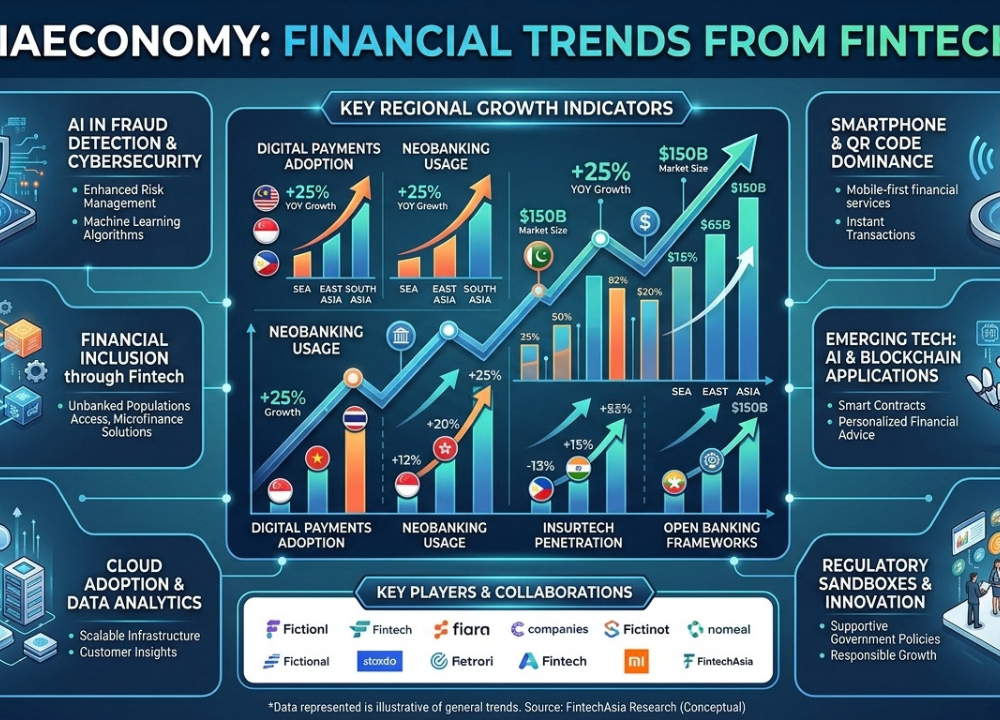
The modern financial system is changing rapidly as technology reshapes how people save, spend, borrow, invest, and manage money. Across Asia, fintech has become an important part of this transformation. Digital payments, mobile banking, artificial intelligence, online lending, embedded finance, and new approaches to financial regulation are changing the way businesses and consumers interact with financial services.
For readers researching Ftasiaeconomy Financial Trends From FintechAsia, the key point is that financial technology should not be viewed as a single industry. It connects banking, commerce, investment, payments, technology, and economic development. Recent coverage of Asian fintech trends has highlighted payments, lending, investment, regulation, cross-border transfers, and SME finance as important areas to watch.
What Are Ftasiaeconomy Financial Trends From FintechAsia?
Ftasiaeconomy Financial Trends From FintechAsia can be understood as a topic focused on financial and fintech developments across Asian markets. The discussion commonly covers digital payments, digital banking, lending, investment technology, artificial intelligence, blockchain, financial inclusion, and regulatory changes.
A related FTAsiaEconomy article describes the subject in terms of digital banking, payment systems, blockchain, AI-driven lending, and fintech regulation. In practical terms, readers can use this topic to understand how technology is influencing financial services and how those changes connect with broader economic conditions.
The important areas include:
- Digital payment adoption
- Mobile banking
- Digital lending
- Artificial intelligence in finance
- Cross-border payments
- SME financing
- Open banking
- Embedded finance
- Blockchain and tokenization
- Financial regulation
- Cybersecurity
- Financial inclusion
Why Asian Fintech Trends Matter
Asia contains a diverse collection of financial markets, from highly developed financial centers to rapidly digitizing emerging economies. That diversity creates different opportunities and challenges for fintech companies. Digital finance can make certain services faster and easier to access. A consumer may be able to open an account through a mobile application, send money instantly, pay a merchant with a QR code, or apply for financing without visiting a traditional branch.
For businesses, technology can simplify payment collection, accounting, customer onboarding, lending, and financial analysis. Recent 2026 reporting on Asian fintech has highlighted differences in economic growth, monetary policy, credit conditions, and regulatory environments across markets.
The Growth of Digital Finance
Traditional financial services once depended heavily on physical branches and paper-based processes. Digital platforms have changed that model.
Today, many services can be delivered through:
- Smartphones
- Mobile applications
- Web platforms
- Digital wallets
- APIs
- Cloud infrastructure
- Automated decision systems
Digital Payments Are Reshaping Everyday Finance
One of the most visible developments discussed in Ftasiaeconomy Financial Trends From FintechAsia is the expansion of digital payments. Mobile wallets, QR-code payments, contactless transactions, payment gateways, and real-time payment networks have become important components of modern commerce.
For consumers, digital payments can provide convenience. For merchants, they can reduce dependence on cash handling and create digital transaction records. However, growth in payment technology also creates business challenges. Competition can place pressure on transaction fees, while companies need to invest in fraud prevention and customer protection.
Mobile Wallets
Mobile wallets allow users to store payment information and complete transactions through smartphones. Their development has been particularly important in markets where mobile technology has expanded faster than traditional banking infrastructure.
Real-Time Payments
Real-time payment systems allow money to move quickly between accounts. They can support consumers, merchants, businesses, and financial institutions by reducing delays in settlement.
Cross-Border Payments
International transfers have traditionally involved multiple intermediaries and can be expensive or slow. New payment infrastructure, APIs, and central-bank initiatives are being explored to improve cross-border settlement.
Digital Banking and Neobanks
Another important part of Ftasiaeconomy Financial Trends From FintechAsia is the development of digital-first banking. Digital banks can provide services without relying on a large network of physical branches. Customers may manage accounts, transfer money, request cards, and access financial products through an application.
The benefits can include:
- Faster account management
- Convenient access
- Lower dependence on physical branches
- Automated customer service
- Personalized financial products
Traditional Banks and Fintech Partnerships
Banks increasingly work with technology companies to improve digital services. Fintech firms may provide payment infrastructure, identity verification, analytics, cybersecurity, or specialized lending technology.
AI Is Changing Financial Services
Artificial intelligence is becoming another major component of Ftasiaeconomy Financial Trends From FintechAsia.
Financial organizations can use AI and machine learning for tasks such as:
- Fraud detection
- Customer support
- Risk analysis
- Credit assessment
- Investment research
- Document processing
- Personalization
AI-Powered Credit Scoring
Traditional credit decisions often rely heavily on established financial records. Newer systems may consider additional information, including transaction behavior and other permitted data. Recent reporting on Asian fintech describes the use of payment and behavioral data in newer credit-scoring models and connects these developments with embedded finance.
Digital Lending and Embedded Finance
Digital lending is changing how some consumers and businesses access credit. Instead of completing a lengthy application through a branch, customers may be able to apply digitally. Automated systems can collect information, assess risk, and provide decisions more quickly.
Embedded finance takes this concept further by integrating financial products into non-financial platforms.
For example, an e-commerce platform might offer:
- Buy-now-pay-later services
- Business financing
- Insurance
- Digital payments
- Working-capital solutions
SME Financing and Financial Inclusion
Small and medium-sized businesses often face difficulties accessing traditional credit. Fintech can provide alternative methods of evaluating business performance. According to recent FinTechAsia coverage, fintech lenders are using information such as sales, inventory, cash flow, and supply-chain data to support SME financing decisions.
This can potentially make financing more accessible, although lenders still need effective risk controls. Financial inclusion is another important consideration. Mobile technology can help bring financial services to people who have historically had limited access to conventional banking.
Why Financial Inclusion Matters
Access to appropriate financial services can support:
- Saving
- Payments
- Entrepreneurship
- Business growth
- Emergency financial management
- Investment participation
Blockchain, Tokenization, and Digital Assets
Blockchain technology continues to influence financial innovation. A blockchain can provide a shared record of transactions and may support applications involving digital assets, tokenization, settlement, and smart contracts. However, blockchain adoption should be considered separately from speculation surrounding individual cryptocurrencies. Financial institutions and regulators may explore blockchain infrastructure even when they take different approaches to particular digital assets.
Regulation and Consumer Protection
Regulation is essential to understanding Ftasiaeconomy Financial Trends From FintechAsia. Financial technology companies operate in environments where governments and regulators need to balance innovation with consumer protection and financial stability.
Key regulatory areas include:
- Data protection
- Cybersecurity
- Anti-money-laundering controls
- Know-your-customer requirements
- Licensing
- Consumer disclosures
- AI governance
- Digital-asset rules
Key Financial Trends at a Glance
| Financial Trend | Main Technology | Potential Business Impact | Key Consideration |
| Digital payments | Mobile wallets, QR payments | Faster transactions | Fraud and fees |
| Digital banking | Apps, cloud systems | Greater accessibility | Security |
| Digital lending | AI, alternative data | Faster credit decisions | Responsible lending |
| Embedded finance | APIs, platforms | New revenue channels | Compliance |
| Cross-border payments | Payment networks, APIs | Faster transfers | Regulation |
| AI in finance | Machine learning | Automation and analysis | Transparency |
| Blockchain | Distributed ledgers | New financial infrastructure | Regulatory uncertainty |
| SME finance | Data analytics | Alternative funding | Credit risk |
How Businesses Can Use Fintech Trends
Companies following Ftasiaeconomy Financial Trends From FintechAsia should avoid treating every new technology as an automatic business opportunity. Instead, businesses can start by identifying actual customer problems. For example, a retailer may need better payment processing. A small business may need working capital. A financial institution may need better fraud detection. A logistics company may need simpler cross-border payments.
Evaluate the Customer Experience
Ask:
- What problem does the technology solve?
- Does it reduce friction?
- Is it easy to use?
- Does it improve speed or accessibility?
- Can customers understand the service?
Evaluate Risk
Companies should also consider:
- Data security
- Operational resilience
- Compliance
- Vendor dependency
- Fraud exposure
- Customer support
How to Analyze Financial Trends
Understanding Ftasiaeconomy Financial Trends From FintechAsia requires more than following headlines.
Monitor Macroeconomic Conditions
Important factors include:
- Inflation
- Interest rates
- Economic growth
- Currency movements
- Government policy
- Credit conditions
Track Consumer Behavior
Changes in customer behavior can reveal whether a technology is becoming part of everyday life.
Useful indicators include:
- Digital payment usage
- Mobile banking adoption
- Online purchasing
- Digital lending demand
- Customer retention
- Transaction frequency
Watch Regulatory Changes
Regulation can change the economics of fintech businesses. A new licensing requirement, data rule, or cybersecurity standard may affect product development and operating costs.
Future of Asian Financial Technology
The future direction of Ftasiaeconomy Financial Trends From FintechAsia will likely depend on several connected forces rather than one technology. AI is expected to remain an important area of financial innovation. Digital payments will continue to develop, while embedded finance may expand the number of places where financial products are offered.
Cross-border payment infrastructure is another important area. Recent reporting has discussed experiments involving central-bank digital currencies and improved settlement arrangements for international transfers. At the same time, cybersecurity and regulatory compliance will become increasingly important as financial systems become more digital.
Trends Worth Watching
Businesses and readers can monitor:
- Artificial intelligence in banking
- Real-time payments
- Digital identity
- Open banking
- Embedded finance
- SME financing
- Cross-border payments
- Tokenization
- Cybersecurity
- Financial inclusion
Common Mistakes When Following Fintech Trends
People researching Ftasiaeconomy Financial Trends From FintechAsia can make several common mistakes.
Relying on One Source
One article rarely provides the complete picture. Compare company announcements, regulatory information, financial data, and reputable industry reporting where possible.
Confusing Adoption With Hype
A technology may receive substantial media attention without achieving widespread practical adoption.
Ignoring Regulation
Financial services operate within regulated environments. A technology’s commercial potential can change significantly when regulations change.
Looking Only at Technology
Economic conditions, customer behavior, competition, and business economics are equally important.
Who Should Follow These Financial Trends?
Ftasiaeconomy Financial Trends From FintechAsia can be relevant to several audiences.
Business Owners
Business owners can monitor payment technology, digital lending, financial automation, and customer-finance solutions.
Fintech Professionals
Professionals can use trend analysis to understand changing technologies, regulatory requirements, and customer expectations.
Investors
Investors researching the sector can examine business models, revenue quality, regulation, market size, competition, and financial performance rather than focusing only on technology narratives.
Final Thoughts
The modern financial industry is being reshaped by technology, but the transformation is broader than simply replacing bank branches with mobile applications. Digital payments, AI, lending platforms, embedded finance, blockchain, cross-border infrastructure, and regulatory developments are all contributing to a more technology-driven financial ecosystem. For anyone researching Ftasiaeconomy Financial Trends From FintechAsia, the most useful approach is to look at the relationship between technology and the wider economy. Consumer behavior, interest rates, regulation, investment, cybersecurity, and financial inclusion all influence how fintech develops.
FAQs
Q1: What are Ftasiaeconomy Financial Trends From FintechAsia?
Ans: Ftasiaeconomy Financial Trends From FintechAsia refers to financial and fintech developments associated with Asian markets, including digital payments, digital banking, lending, AI, investment technology, regulation, and financial inclusion.
Q2: Why are fintech trends important in Asia?
Ans: Asian markets are experiencing significant digital transformation in financial services. Mobile payments, digital banking, lending technology, and other innovations are changing how consumers and businesses access and use financial products.
Q3: What are the biggest fintech trends in Asia?
Ans: Major areas include digital payments, mobile banking, embedded finance, AI-powered financial services, digital lending, cross-border payments, blockchain applications, and stronger cybersecurity and regulatory systems.
Q4: How is AI being used in financial services?
Ans: AI can support fraud detection, customer service, credit assessment, document processing, risk analysis, and personalization. Financial organizations must also address issues involving data quality, privacy, security, and transparency.
Q5: What is embedded finance?
Ans: Embedded finance means integrating financial products into non-financial platforms. Examples can include payments, lending, insurance, or financial accounts offered directly through shopping, transportation, software, or other digital services.
Q6: How does fintech support small businesses?
Ans: Fintech can provide digital payments, online accounting, alternative lending, cash-flow analysis, and other services. Data-driven underwriting can also help lenders evaluate some businesses using information beyond traditional credit records.
Q7: What risks are associated with fintech?
Ans: Important risks include cybersecurity threats, fraud, privacy problems, operational failures, regulatory uncertainty, inappropriate lending, and dependence on technology providers.
